Problem Quality: The Difference Between an Annoyance and a Venture-Grade Opportunity

By Zach Warshawsky
One of the easiest mistakes in venture work is confusing the existence of a problem with the existence of an opportunity.
A problem can be real, visible, frustrating, and still not be worth building around. That distinction matters because many early-stage efforts begin too close to irritation and too far from structural necessity. The result is a familiar pattern: a team identifies something inefficient, annoying, or outdated, assumes that frustration implies demand, and starts building before asking whether the problem is actually strong enough to support a venture.
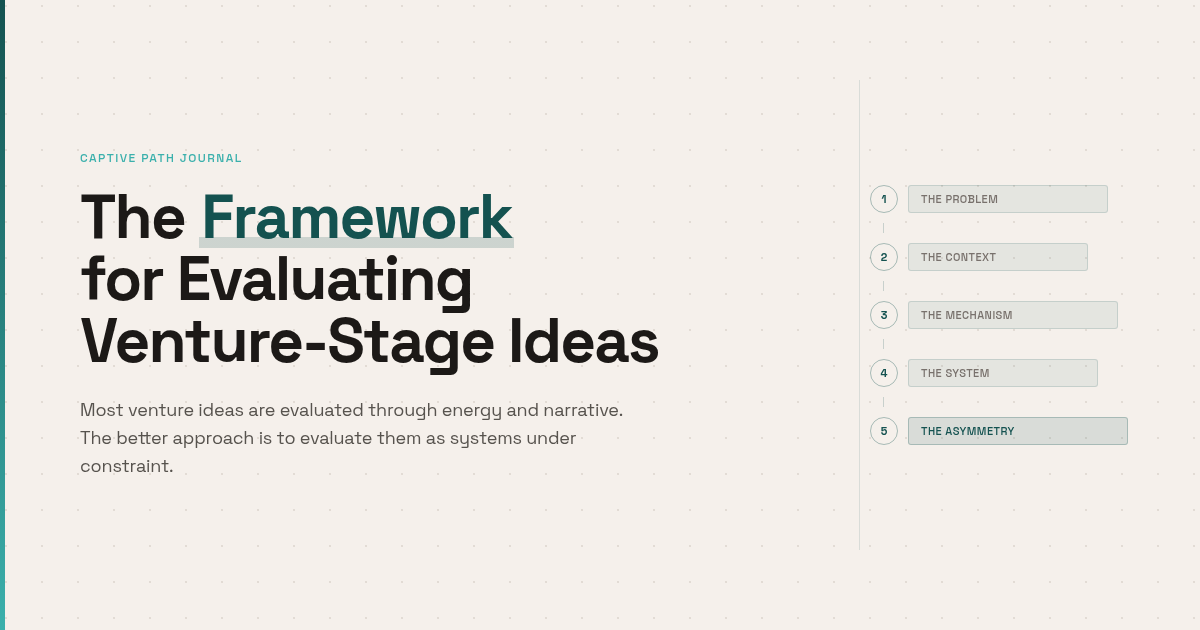
This is where problem quality becomes decisive. It is the first lens in the framework for evaluating venture-stage ideas.
Problem quality is the degree to which a problem possesses the weight, urgency, structural relevance, and economic gravity necessary to justify serious venture effort. It is not enough for something to be inconvenient. It must matter in a way that creates durable pressure for a solution.
Why teams get this wrong
There are several reasons weak problems get overvalued.
First, irritation is easy to notice. It is legible. People feel it directly, and that makes it tempting to treat the experience itself as proof of significance.
Second, many teams assume that if they can imagine a cleaner interface, faster workflow, or more pleasant experience, then the market must want a solution badly enough to sustain a business. But not every inefficiency is economically meaningful. Not every awkward process carries enough pain to change behavior.
Third, the startup environment tends to romanticize discovery. Once a problem is named, teams become attached to the story of solving it. The problem starts to feel stronger simply because it has narrative momentum.
None of this means weak problems are imaginary. It means they are frequently overinterpreted.
The difference between annoyance and venture-grade pressure
A minor annoyance is something people dislike but can easily tolerate, ignore, route around, or postpone indefinitely. It may be genuinely suboptimal. It may even be widely recognized. But it does not create enough pressure to compel search, switching, purchase, or organizational change.
A venture-grade problem is different. It imposes pressure. It creates repeated cost, friction, exposure, delay, risk, inefficiency, or lost upside at a level that meaningfully affects behavior.
That pressure can take several forms:
- economic pressure
- operational pressure
- compliance or risk pressure
- coordination pressure
- reputational pressure
- timing pressure
- strategic pressure
What matters is not whether the problem exists. What matters is whether the consequences of leaving it unsolved are strong enough to create sustained demand for a better outcome.
Five lenses for assessing problem quality
1. Severity
How painful is the problem when it appears?
Severity is not about whether someone complains. It is about what the problem actually costs when it becomes active. Does it materially affect money, time, operations, error rates, quality, trust, or growth? Does it create recurring damage, or is it simply unpleasant?
A severe problem changes behavior. A mild problem generates commentary.
2. Frequency
How often does the problem occur?
Even a meaningful issue may not justify a venture if it appears too rarely. A strong problem usually recurs with enough frequency that the cost accumulates. Frequency is what turns isolated pain into structural pain.
A problem that appears once a year may matter. A problem that appears weekly or daily exerts a different kind of pressure.
3. Intolerance
How willing are people to continue living with the problem?
This is one of the least discussed but most important lenses. Some problems are severe in theory but tolerated in practice because the market has normalized them. Others are only moderately painful but highly intolerable because the alternatives are becoming more visible and expectations are changing.
A problem becomes more venture-grade when the willingness to tolerate it begins to erode.
4. Economic relevance
Does solving the problem unlock real value?
Many issues are experientially annoying without being economically meaningful. A venture-grade problem usually sits closer to money, throughput, risk, margin, retention, or strategic leverage. The economic link does not need to be immediate, but it needs to exist.
This is why some “beautifully solved” products struggle. They reduce friction around a problem that never carried enough economic significance to drive strong adoption.
5. Structural persistence
Is the problem likely to remain meaningful long enough for a venture to matter?
Some problems are transient artifacts of a temporary workaround, short-lived tool gap, or momentary market transition. Others are embedded deeply in how systems, organizations, regulations, incentives, or human behavior actually function.
Structural persistence matters because a venture should not depend on a short half-life problem unless the speed of execution and timing are extraordinarily strong.
What a high-quality problem usually looks like
A high-quality problem often has a recognizable profile.
- It creates recurring pressure.
- It is costly in a meaningful way.
- It affects behavior or outcomes directly.
- Existing workarounds are inadequate, expensive, or fragile.
- The pain is not just visible. It is consequential.
- Solving it has a plausible path to durable value creation.
That does not mean everything has to look enormous immediately. But it does mean the opportunity should feel structurally substantial, not cosmetically frustrating.
What low-quality problems tend to look like
Low-quality problems often share a different pattern.
- They are easy to describe but hard to monetize.
- People complain about them but do not prioritize solving them.
- Workarounds are annoying but acceptable.
- The cost of inaction is low.
- The pain is more aesthetic than structural.
- The urgency lives more in the founder’s interpretation than in the market’s behavior.
These are dangerous because they often sound convincing in a pitch. They feel modern, relatable, and fixable. But relatability is not the same thing as venture quality.
Why this matters in evaluation
Problem quality should sit near the beginning of any serious evaluation process. If the problem is weak, everything built on top of it becomes harder.
- messaging gets inflated
- distribution gets more difficult
- pricing gets weaker
- adoption friction becomes harder to overcome
- retention becomes harder to sustain
- the venture needs more narrative force than structural force
This is one reason many teams end up over-indexing on branding, growth tactics, or product polish. They are trying to compensate for a weak underlying problem.
That rarely works well for long.
A better question to ask
Instead of asking only, Is this a real problem?, a stronger question is:
Is this problem strong enough that leaving it unsolved creates meaningful pressure for enough people in a way that can support durable value creation?
That is a more demanding question. It is also a better one.
It forces the team to move past empathy theater and into structural assessment. It asks whether the venture would be solving something consequential, not merely observable.
What this changes in practice
Teams evaluating opportunities should build a habit of testing problem quality before they become attached to solution language.
They should ask:
- What is the actual cost of this problem?
- How often does it occur?
- Who feels it most acutely?
- What are people doing now instead?
- Why has the problem remained unsolved?
- What makes this consequential rather than simply irritating?
If the answers remain soft, the opportunity probably is too.
The best venture opportunities usually begin not with a clever idea, but with a stronger problem than most people are willing to look for. That is why problem quality matters. It determines whether the work ahead is being built on pressure or on preference.