Asymmetry Is Not a Buzzword: What It Should Mean in Practice

By Zach Warshawsky
Asymmetry is one of those terms that sounds sophisticated enough to survive without being defined. It appears in venture conversations, investor language, strategy decks, and startup analysis as if everyone agrees on what it means.
Usually they do not.
In practice, asymmetry is often used as a flattering synonym for upside. If an idea seems interesting, differentiated, or potentially large, someone will call it asymmetric. But that usage is too loose to be useful.
Real asymmetry is not just the possibility of a good outcome. It is a structural condition in which the upside, leverage, or strategic advantage available to a specific opportunity is meaningfully greater than what would normally be expected relative to the effort, risk, or position involved.
That definition is still abstract, so it helps to simplify it.
Asymmetry exists when there is a meaningful imbalance in favor of the opportunity.
Not a fantasy. Not enthusiasm. Not mere optionality. A real imbalance.
Why the term gets abused
The startup environment likes language that signals sophistication while remaining ambiguous. Asymmetry survives in that environment because it flatters judgment. Calling something asymmetric makes it sound sharper than simply saying it has potential.
The problem is that this weakens the concept. If every attractive opportunity is called asymmetric, the term stops filtering anything.
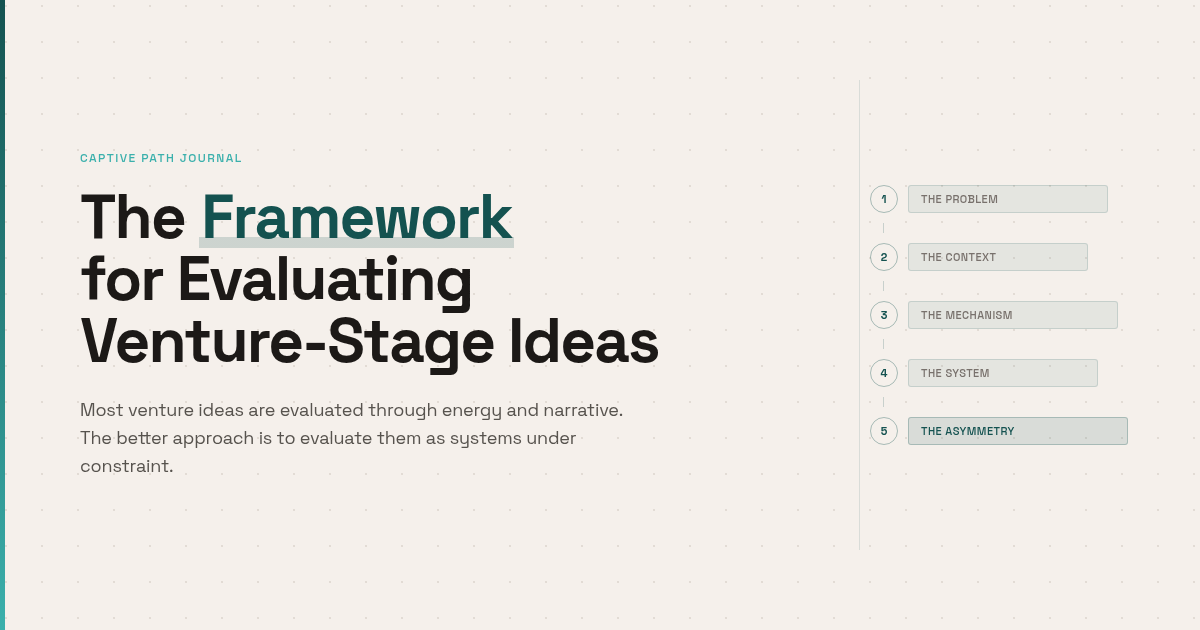
That matters because asymmetry, properly understood, is one of the most useful evaluation lenses in early-stage work. It helps identify whether an opportunity has unusual structural leverage or whether it merely looks appealing on the surface. Asymmetry is one of the five lenses in the venture-stage evaluation framework.
What real asymmetry can come from
Asymmetry is not one thing. It can emerge from several kinds of advantage.
1. Information asymmetry
The team sees something important earlier or more clearly than most others.
This does not mean possessing trivia or niche observations. It means understanding a meaningful problem, behavioral shift, market pattern, or hidden inefficiency in a way that materially improves timing or decision quality.
2. Access asymmetry
The team has privileged access to a market, workflow, distribution channel, customer segment, relationship network, or operating environment that others cannot easily replicate.
This kind of asymmetry is powerful because it reduces friction. It changes not just what the team knows, but what it can actually do.
3. Capability asymmetry
The team can execute in a way that is unusual for the category.
This could come from technical depth, operating experience, domain fluency, systems thinking, or the ability to coordinate several competencies in a way competitors cannot easily match.
4. Cost asymmetry
The team can pursue the opportunity more efficiently than others.
This may come from infrastructure, prior assets, distribution leverage, process design, or a structural ability to reach meaningful proof without incurring the normal cost profile.
5. Timing asymmetry
The market is shifting in a way that creates a temporary but meaningful opening.
Timing asymmetry is often misunderstood because many people confuse trend awareness with timing advantage. Real timing asymmetry usually exists when a team can act during a window in which the opportunity is becoming viable before the category becomes crowded or obvious.
What asymmetry is not
To use the lens correctly, it helps to remove the false positives.
Asymmetry is not:
- a large market by itself
- a clever idea by itself
- a strong product preference by itself
- general optimism about upside
- vague differentiation language
- the hope that things could go very well
A large market without structural advantage is not asymmetry. A good product without meaningful leverage is not asymmetry. An idea that sounds modern is definitely not asymmetry.
How to test for it in practice
Ask what is actually tilted
If an opportunity is claimed to be asymmetric, what exactly is tilted in its favor?
- Is there an information edge?
- a capability edge?
- a timing edge?
- a distribution edge?
- a cost edge?
If the answer is vague, the asymmetry probably is too.
Ask whether the edge is specific to this team
An opportunity can be attractive in general without being asymmetric for the team in front of it. Real asymmetry is often specific, not universal.
This is a crucial distinction. A market may be attractive overall, but if the team has no unusual access, insight, capability, or timing, the opportunity may not be asymmetric for them.
Ask whether the advantage compounds
Strong asymmetry usually creates second-order benefits.
An access advantage may reduce acquisition cost and improve learning speed. A systems advantage may increase execution quality and lower complexity. A timing advantage may enable faster category positioning before competitors converge.
If the claimed edge does not compound, it may still be useful, but it is less likely to represent meaningful asymmetry.
Ask whether the edge survives contact with reality
Many opportunities appear asymmetric in a deck because assumptions are still clean. Once distribution, execution, coordination, or market friction enters the picture, the advantage becomes thinner.
A serious evaluation should pressure-test whether the asymmetry remains meaningful under real constraints.
Why asymmetry matters in venture evaluation
Asymmetry matters because early-stage environments are uncertain. In uncertainty, small structural advantages matter more. The team cannot rely on perfect information, smooth execution, or guaranteed demand. It needs something in the setup that creates favorable imbalance.
Without asymmetry, a venture may still succeed, but it is operating on a flatter field. The path depends more heavily on flawless execution, better luck, or outcompeting others without any real structural tilt.
That is a weaker starting position.
A more disciplined way to use the term
A useful rule is simple: do not call something asymmetric unless you can name the actual source of the imbalance and explain why it matters.
If the edge cannot be named, it should not be trusted.
If the edge can be named but not defended, it should not drive conviction.
If the edge is real, specific, and consequential, then asymmetry becomes a serious evaluation concept rather than a flattering buzzword.
What this changes in practice
Teams should start using asymmetry as a filter instead of a compliment.
That means asking:
- What is structurally better here than it would be in an average opportunity?
- Why is that true now?
- Why is it true for this team?
- What becomes easier, faster, cheaper, or more defensible because of it?
- Does that advantage persist long enough to matter?
Those questions sharpen evaluation. They separate interesting opportunities from advantaged ones.
That is what the term is supposed to do.
Real asymmetry is rare enough to be useful. The moment it becomes language for generic upside, it stops doing any work at all.