Sequencing Work: What to Solve First in a New Venture

By Zach Warshawsky
Many early-stage ventures do not fail because nothing was done. They fail because too much was done in the wrong order.
This is one of the most common structural problems in new ventures. A team senses urgency, starts moving, and begins solving whatever feels closest or most tangible. A deck is polished before the problem is fully defined. Brand work appears before positioning is clear. Product work starts before decision criteria are stable. Marketing experiments begin before the operating logic is coherent.
The result is not laziness. It is mis-sequencing.
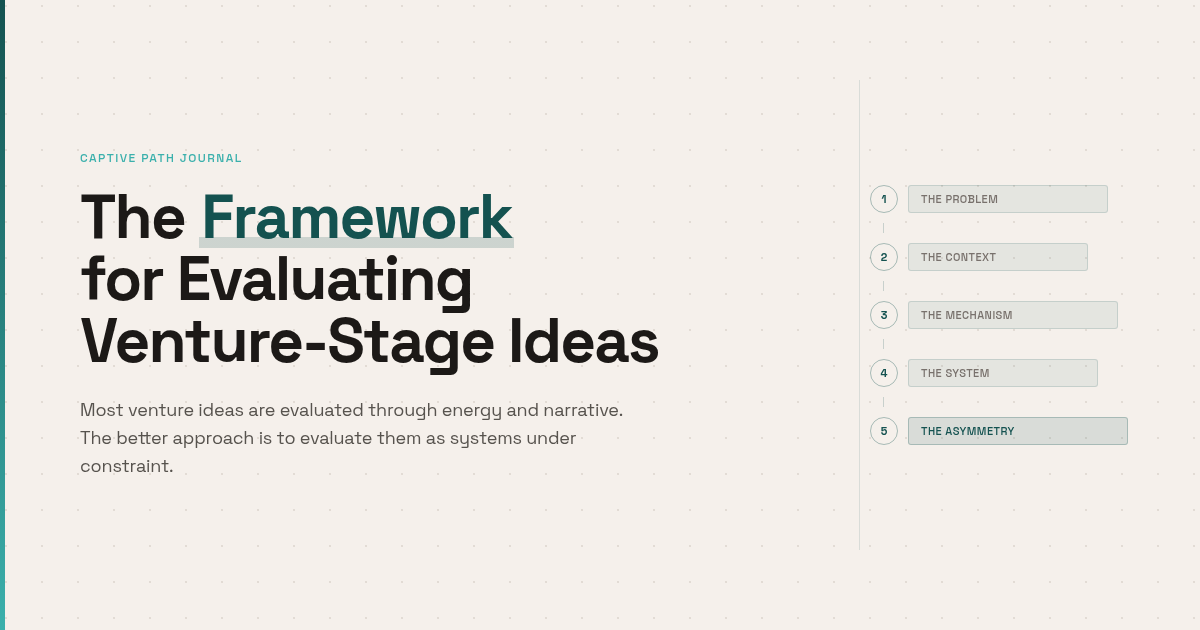
In early-stage work, order matters more than many teams want to admit. The same tasks completed in a better sequence can create dramatically better outcomes, because each layer of work becomes more informed by the one before it. Sequencing connects directly to the framework for evaluating venture-stage ideas, where the order of the five lenses is itself a sequencing decision.
Why sequencing is such a hidden variable
Most teams acknowledge that priority matters, but fewer think carefully about sequence. Priority answers what matters. Sequence answers what must come first so the next layer of work is not distorted.
That is a more structural question.
Operating model and systems literature makes this point in other contexts: work becomes more effective when strategy, process, and organizational structure are aligned rather than developed in isolation. The same principle becomes even more important in a venture environment, where uncertainty is high and early decisions compound quickly.
Mis-sequencing is dangerous because it often masquerades as productivity. The team is moving. Deliverables exist. But if the order is wrong, the work is built on unstable assumptions.
The default failure pattern
A common sequence in weak early-stage ventures looks something like this:
- Excitement about the idea.
- Immediate movement into external-facing activity.
- Asset creation, pitch language, or product effort.
- Reactive attempts to clarify strategy later.
- Mounting confusion when execution becomes noisy.
The issue is not that any one of those actions is inherently wrong. The problem is that the venture has started expressing itself before it has sufficiently structured itself.
This creates waste in three forms:
- work has to be redone later
- early signals become harder to interpret
- the team develops momentum around unstable assumptions
A better sequence
There is no universal recipe, but there is a better default order.
1. Clarify the opportunity
Before a venture accelerates, it needs a cleaner answer to basic questions.
- What problem is actually being addressed?
- Why does it matter enough?
- For whom is it urgent?
- What makes this opportunity structurally interesting rather than merely plausible?
- What would have to be true for this to become meaningful?
This is not branding work. It is not market theater. It is the beginning of strategic clarity.
Without this layer, later activity is likely to produce artifacts that look coherent but are built on a vague or unstable premise.
2. Evaluate the quality of the opportunity
Once the opportunity is clarified, it still needs to be tested. Not every clearly articulated idea deserves progression.
This is where evaluation enters. The team should examine problem quality, asymmetry, timing, model fit, execution complexity, and whether the opportunity actually warrants deeper commitment. The point is not to predict certainty. It is to strengthen selection before operating depth increases.
This stage is often underdeveloped because teams want movement. But skipping it means the venture starts building against a premise that has not survived enough scrutiny.
3. Define the operating logic
If the opportunity survives evaluation, the next task is not always to build immediately. Often it is to define the operating logic.
That means clarifying how the venture intends to work.
- What is the initial model?
- What is the real path to value creation?
- What capabilities matter first?
- Which constraints are real?
- What kind of execution rhythm will be needed?
Operating model work is crucial here because structure translates intent into action. Research on operating design repeatedly emphasizes that strategy alone is insufficient; execution depends on the way work, technology, governance, and roles are actually organized.
A venture without this layer often enters build mode too early and then discovers that the system supporting the work was never defined.
4. Design the minimal internal system
Before scale, a venture needs just enough internal infrastructure to avoid disorder.
This does not mean creating corporate bureaucracy. It means defining the minimum useful system for:
- decisions
- information flow
- priorities
- responsibilities
- learning loops
- operating cadence
This is one of the most misunderstood stages because many founders delay infrastructure until the pain becomes obvious. But by then, misalignment has already been embedded. Early-stage systems guidance often stresses balancing simplicity with integration and clarity precisely because fragmented tools and ambiguous workflows create avoidable drag.
The goal is not premature process. It is preventing chaos from becoming the default operating model.
5. Build the first external surface area
Only after the opportunity is clarified, evaluated, structurally defined, and minimally supported should the venture begin expressing itself more aggressively in public-facing form.
This may include:
- product work
- messaging
- brand surface area
- demand testing
- early acquisition experiments
- partner conversations
At this point, those activities become more useful because they are informed by stronger assumptions. The signals they generate are cleaner. The team can interpret what is happening with more confidence.
6. Accelerate selectively
Acceleration is not the start of the sequence. It is the result of a sequence that has earned acceleration.
Once the venture has a clearer opportunity, stronger evaluation, a defined operating logic, and a minimal internal system, speed becomes more meaningful. Execution is no longer just activity. It begins to compound.
What teams usually get wrong
They externalize too early
Many ventures want to test through public activity before internal clarity exists. But external signals are only useful when the team knows what it is actually testing.
They confuse assets with progress
Landing pages, decks, prototypes, and marketing outputs can create a sense of accomplishment. But they may simply be polished artifacts built on unresolved strategic confusion.
They delay system design until pain forces it
By the time a team notices decision chaos, communication drag, or execution fragmentation, it is already paying for a sequencing error.
They assume speed compensates for bad order
It does not. Speed amplifies sequence. If the order is wrong, faster work often creates faster confusion.
Sequencing as a strategic discipline
Good sequencing is a discipline of restraint. It asks the venture to solve the next necessary layer before indulging every available action.
That discipline is hard because early-stage environments reward visible movement. But serious work is not measured by how fast everything starts. It is measured by whether the venture is building on layers strong enough to support the next phase.
In this sense, sequence is a form of strategy. It determines whether clarity precedes expression, whether evaluation precedes commitment, whether structure precedes acceleration.
What this changes in practice
When a new venture begins, the team should ask a different question.
Not: What can we do right now?
Instead: What must be solved first so that everything that follows becomes sharper, cleaner, and more interpretable?
That question produces better order. Better order produces better signals. Better signals produce better decisions.
And better decisions are what allow early-stage work to become real progress rather than just effort arranged at speed.